Lucknow, June 27, 2025 As the Muharram moon was sighted, an atmosphere of grief and devotion enveloped Lucknow, the capital of Uttar Pradesh. On Friday, June 27, 2025, at 8:00 PM, the 186-year-old Shahi Zari procession, a symbol of Awadh’s Nawabi culture, commenced with grandeur from the Bada Imambara and proceeded to the Chota Imambara. This procession is not only a religious event but also a reflection of Lucknow’s Ganga-Jamuni tehzeeb (composite culture) and cultural identity.
**Historical Significance and Nawabi Tradition**
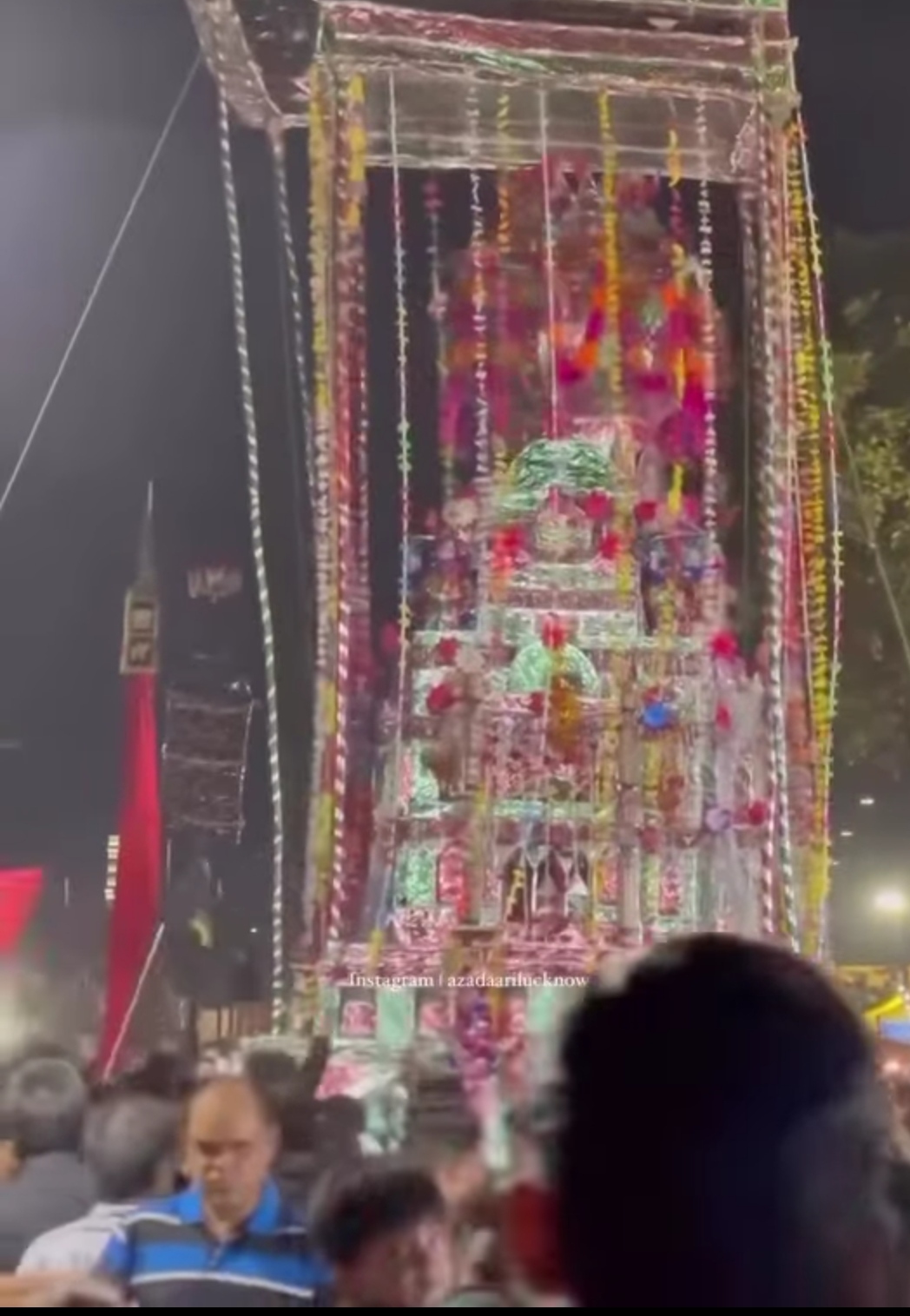
The Shahi Zari procession is part of a tradition initiated in 1839 by the third ruler of Awadh, Nawab Mohammad Ali Shah. Rooted in the Nawabi era, the procession features the Shahi Zari, elephants, horses, camels, bands, and other Nawabi symbols, bringing Lucknow’s historical and cultural heritage to life. This year, the centerpiece was a 22-foot-tall, 10-quintal wax Shahi Zari, depicting the architectural splendor of the Bada Imambara, meticulously crafted by artisan Waseem and his family through tireless efforts.
The procession began at Bada Imambara, passing through Rumi Gate, Lajpat Nagar, Ghantaghar, Satkhanda, and Naubatkhana, before concluding at Hussainabad’s Chota Imambara. Thousands of devotees chanted “Ya Hussain,” commemorating the martyrdom of Imam Hussain and his 72 companions in the Battle of Karbala. In Karbala, Imam Hussain and his followers, enduring hunger and thirst for three days, sacrificed their lives to uphold Islamic principles against the tyrannical Yazid, a legacy this procession honors.
**Stringent Security and Administrative Preparations**
To ensure a peaceful and orderly procession, the police administration implemented robust security measures. Under the leadership of DCP West and ADCP, personnel from the police, PAC, SSB, and Rapid Action Force (RAF) were deployed along the route. CCTV cameras and drones monitored the procession, while traffic was managed with diversions on 15 routes. Pillars under Rumi Gate were removed to ensure smooth passage. Police Commissioner Amrendra Sengar personally inspected security arrangements in Old Lucknow late at night.
**A Symbol of Ganga-Jamuni Tehzeeb**
The Shahi Zari procession transcends the Shia community, with people from various faiths participating, reflecting Awadh’s cultural unity. Along the route, sabeels (stalls) were set up to distribute sherbet, tea, and water to devotees. Mourning groups performed nauha-khwani (recitation of elegies) and seenazani (chest-beating), while marsiyas (elegiac poems) were recited, intensifying the somber mood.
**Artisans’ Dedication and the Shahi Zari’s Uniqueness**
The Shahi Zari was crafted with months of effort by artisans. This year’s Zari, adorned with 20 small and four large domes, stood out as a masterpiece of craftsmanship, symbolizing the architectural grandeur of the Bada Imambara.