







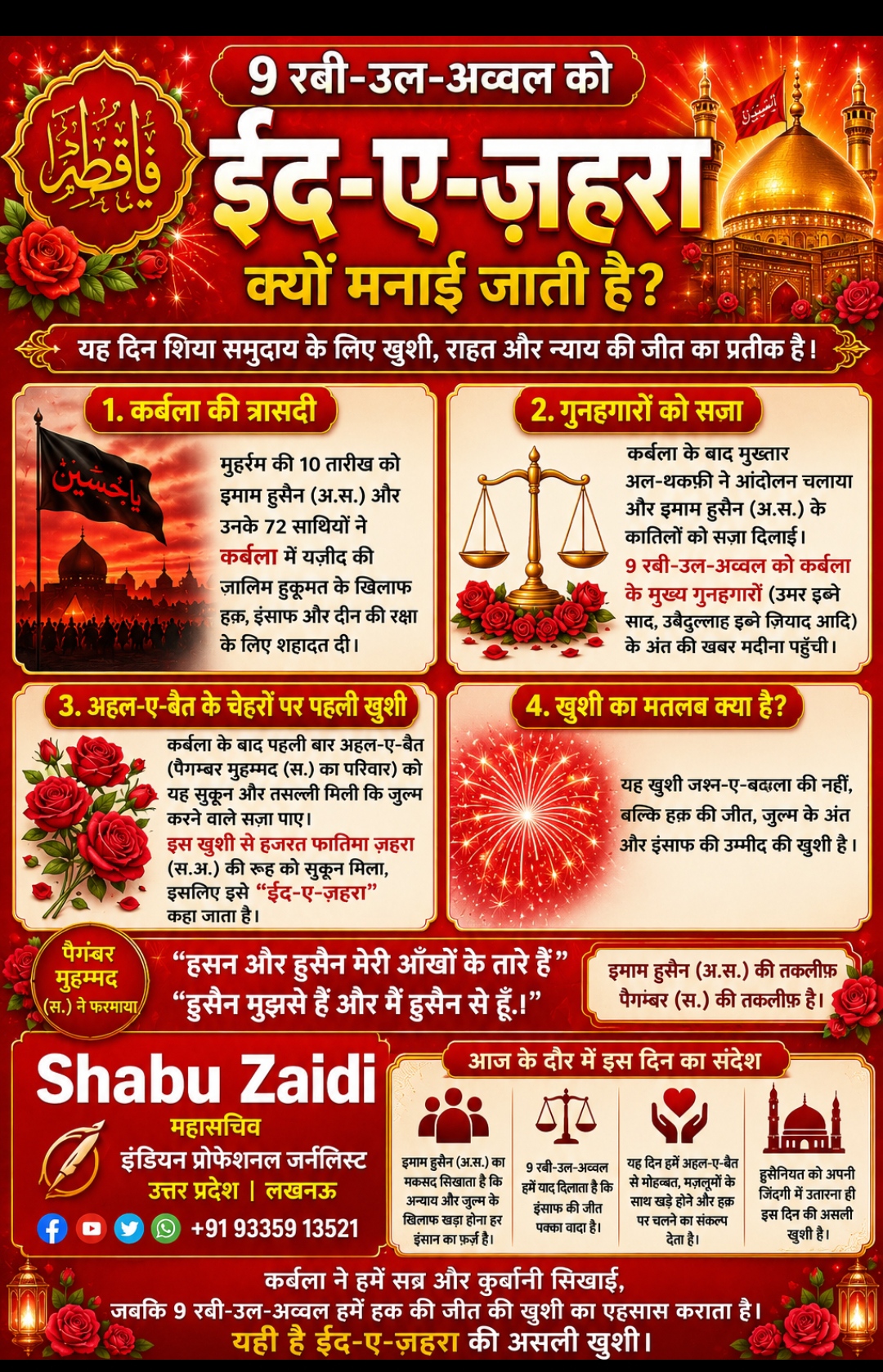
9 Rabi-ul-Awwal: Why Is It a Day of Happiness for the Shia Community? — The Tradition of Eid-e-Zehra and the Mission of Hussain
Shabu Zaidi
The 9th of Rabi-ul-Awwal is regarded by the Shia community as a special day of happiness and gratitude. It is commonly known as Eid-e-Zehra, and in many places, it is also referred to as Eid-e-Shuja. This happiness is not merely a worldly celebration; rather, it is connected with love for the Ahl-e-Bait after Karbala, opposition to oppression, and a commitment to follow the path taught by Imam Hussain (A.S.).
From the Remembrance of Karbala to Happiness
From the 1st of Muharram, the Shia community remembers the martyrdom of Imam Hussain (A.S.) and his companions. At Karbala, Imam Hussain (A.S.), along with his family and companions, refused to bow before oppression. His struggle was not for political power, but for the protection of truth, justice, humanity, and the fundamental values of religion.
The martyrdom of Imam Hussain (A.S.) at Karbala gave the world the message that standing for truth and justice is more important than numbers or power. Therefore, for the Shia community, Muharram is not merely a period of mourning; it is also a time to understand the mission of Imam Hussain (A.S.) and bring his teachings into our lives.
The Reason for the Happiness of 9 Rabi-ul-Awwal
According to Shia religious tradition, the 9th of Rabi-ul-Awwal is observed with happiness in remembrance of events associated with action against the perpetrators of oppression at Karbala and their eventual downfall. In particular, the movement of Mukhtar al-Thaqafi is remembered in connection with seeking justice against those responsible for the tragedy of Karbala.
However, different historical sources contain varying accounts regarding the events and dates associated with this day. Within Shia religious tradition, the 9th of Rabi-ul-Awwal holds significance as a symbol of happiness for the Ahl-e-Bait and hope for the end of oppression.
For this reason, it is known as Eid-e-Zehra—a celebration associated with the happiness of Hazrat Fatima Zahra (S.A.).
Imam Hasan and Imam Hussain in the Eyes of the Prophet of Islam
To understand the martyrdom of Imam Hussain (A.S.), it is essential to understand the love of Prophet Muhammad (S.A.W.) for the Ahl-e-Bait. In well-known traditions, the Prophet of Islam (S.A.W.) expressed his deep affection for Imam Hasan and Imam Hussain (A.S.).
The meaning of a famous narration is that “Hasan and Hussain are my fragrant flowers in this world,” while another widely known Hadith states:
“Hussain is from me, and I am from Hussain.”
Therefore, the suffering of Imam Hussain (A.S.) cannot be viewed separately from the suffering of the Prophet (S.A.W.). The tragedy of Karbala was not merely a tragedy of one family; it was a test of humanity and justice.
What Does Happiness Mean?
The happiness associated with the 9th of Rabi-ul-Awwal should not mean hurting the sentiments of another community or any individual. The fundamental spirit of this day is love for the Ahl-e-Bait, happiness at the victory of truth, and hope for the end of oppression.
The mission of Imam Hussain (A.S.) teaches us that a human being should not remain silent in the face of injustice, regardless of how powerful the force standing before him may be.
If the message of Karbala is limited only to mourning, then a significant part of Imam Hussain’s mission remains incomplete. Similarly, the happiness of 9 Rabi-ul-Awwal becomes meaningful only when it brings us closer to truth, justice, humanity, and the teachings of the Ahl-e-Bait.
The Message of 9 Rabi-ul-Awwal in Today’s World
At a time when society faces numerous challenges of hatred, violence, discrimination, and injustice, the message of Imam Hussain (A.S.) becomes even more important.
Karbala teaches us that standing for truth is the real success, while the happiness of 9 Rabi-ul-Awwal reminds us that oppression does not last forever and that hope for justice must always remain alive.
Therefore, for the Shia community, this day is not merely an occasion for celebration, but also a day of commitment—to bring Hussainiyat into our lives, never to oppress anyone, never to take away anyone’s rights, and to stand with the oppressed wherever possible.
Karbala taught us patience and sacrifice, while 9 Rabi-ul-Awwal gives us the feeling of happiness at the triumph of truth.
This is the essence of the happiness of Eid-e-Zehra—love for the Ahl-e-Bait, hatred of oppression, and a commitment to walk on the path of justice.