





From 12 to 17 Rabi-ul-Awwal: The Birth of the Prophet of Islam ﷺ, Unity, and the Message for the Ummah
Shabu Zaidi
Lucknow | August 24, 2026
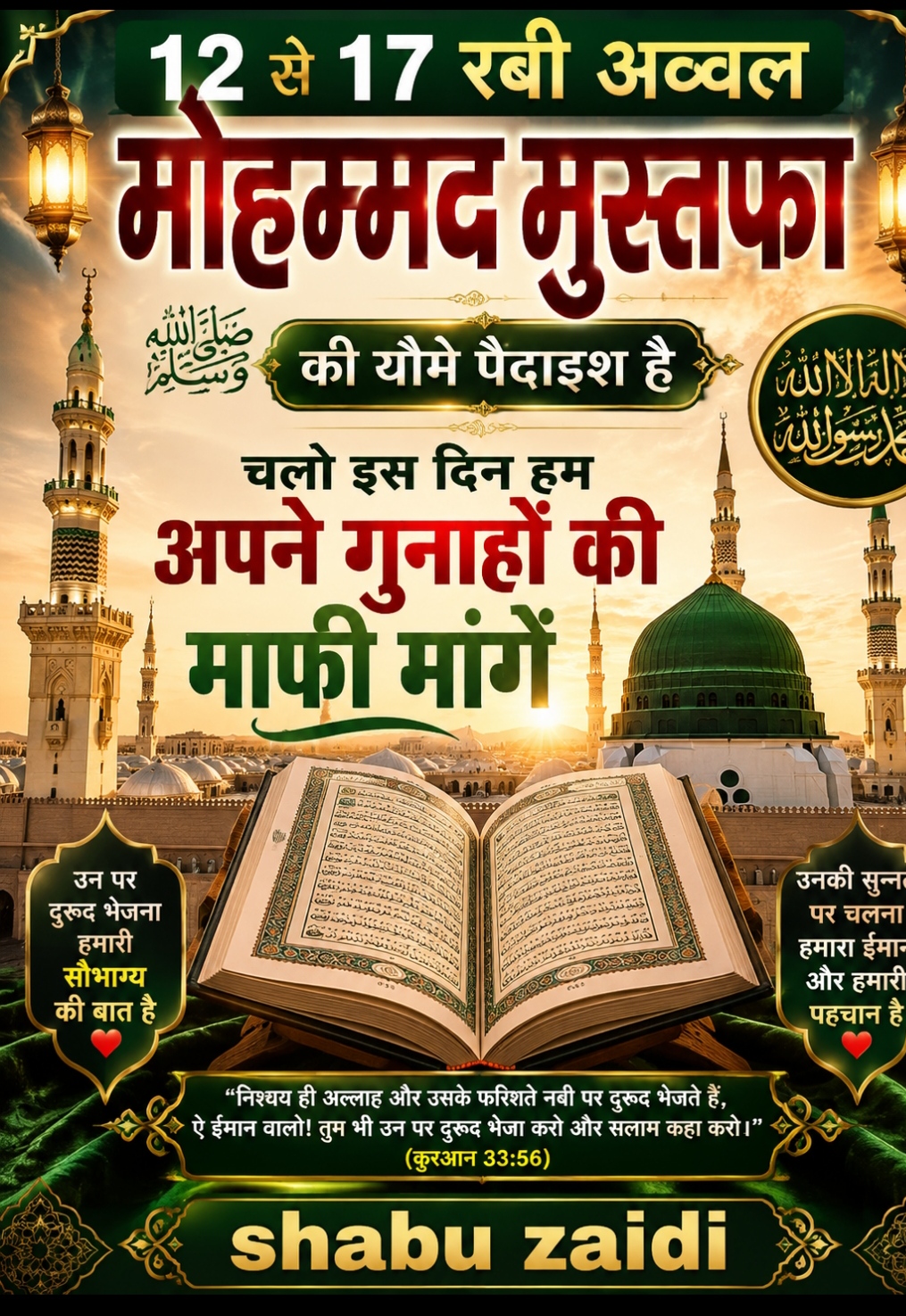
The period from 12 to 17 Rabi-ul-Awwal is an opportunity for the entire Muslim Ummah to remember the Prophet of Islam, Hazrat Muhammad Mustafa ﷺ, reflect upon his life and character, and understand his teachings. Although there are differences among various Muslim traditions regarding the exact date of his birth, the entire Ummah agrees that the Messenger of Allah ﷺ is the final Prophet of Allah and Rahmat-ul-lil-Alameen (a mercy to all the worlds).
The Holy Qur’an mentions Hazrat Muhammad ﷺ by names such as “Muhammad” and “Ahmad.” He is also described with honorific titles such as Rasoolullah, Nabi, Shaheed, Mubashshir, Nazeer, Dai Ilallah, and Sirajam Munira. “Muhammad” means “the one who is greatly praised,” while “Ahmad” is understood to mean “the most praised.”
The Qur’an also states that Hazrat Isa (Jesus), peace be upon him, gave glad tidings of a Messenger who would come after him, whose name would be Ahmad.
What was the message of the Prophet ﷺ?
The greatest message of the life and teachings of the Prophet of Islam ﷺ was humanity, justice, mercy, brotherhood, and worship of Allah. We claim to follow his Sunnah, but the question is: Are we also following his greatest teaching—the message of unity and brotherhood within the Ummah?
The condition of Muslims today can be understood through the example of a huge tree whose roots are one, whose trunk is one, and whose source of nourishment is one, yet whose branches appear scattered because of divisions and differences. To bring these scattered branches together, emotions alone are not enough. We need wisdom, knowledge, guidance, patience, and respect for one another.
Why do some people object to celebrating the Prophet’s ﷺ birth?
One section of Muslims believes that there should be no special tradition of celebrating the birth of the Prophet ﷺ, while another section considers it a means of expressing love for their Prophet ﷺ. This difference may exist, but the question is: Is it right to turn such differences into hatred and hostility?
If a Muslim expresses happiness by remembering the birth of the Prophet ﷺ, speaks about his life and character, recites Durood, helps the poor, and invites people to follow his noble character, then at the very least, we should learn to respect one another’s intentions and emotions.
Today, what we need is unity—not arguments
In different parts of the world, innocent children and young people are facing difficult circumstances. At such a time, can we not put aside our minor differences in the name of the Prophet ﷺ and come closer to one another?
Can we not gather together and offer prayers?
Can we not sit together and pray to Allah?
Can we not respect and love one another as fellow Muslims?
Being part of the Ummah of the Prophet ﷺ is not merely a matter of claiming it. Being his Ummah demands that we bring his teachings of good character, justice, mercy, truthfulness, and brotherhood into our lives.
On the Day of Judgment, all of us will stand before the same Lord. Therefore, the need of the hour is to support one another rather than pull each other down, spread love instead of hatred, and seek knowledge instead of engaging in endless arguments.
The message of 12 to 17 Rabi-ul-Awwal is not only one of celebration, but also one of self-reflection—how much do we truly love our Prophet ﷺ, and how much of his Sunnah have we incorporated into our lives?
The most beautiful proof of our love for the Messenger ﷺ is to work toward bringing his Ummah together, not dividing it.